The Growth Hack Nobody Wants: Make it Harder to Buy
For pre-PMF SaaS, opening all doors = spraying efforts everywhere and praying they're ICPs. Strategic friction reveals who actually wants to buy.
We added a demo booking step to our onboarding flow. Made it look mandatory (but secretly skippable if you paid attention).
Onboarding completions dropped 40%.
But something interesting happened: 4-5 out of every 10 demos converted to paid POCs. And for the first time, we could see a pattern in who was buying.
This goes against everything we’ve been told about reducing friction.
But here’s what most GTM advice misses: that advice is for companies that already know their ICP. For pre-PMF businesses, it’s a recipe for disaster.
Let me explain.
When you’re still figuring out who your customer is, opening your funnel wide seems logical. Cast a wide net, analyze patterns, figure it out, right?
But you end up chasing every lead with equal intensity. Most don’t convert. The few that do are so different from each other that instead of finding patterns, you get more confused.
Meanwhile, you’re burning cash, your team is exhausted, and you still have no idea who your working ICP is.
I’ve lived this nightmare. And I’ve seen why it happens:
- You haven’t defined a beachhead ICP - you’re testing everything on everyone
- You confuse activity with progress - the possibility of any sale makes you forget why you opened the funnel wide in the first place
There’s a better way:
- Define a beachhead ICP (with actual evidence, not hunches)
- Add strategic friction to filter for that ICP
Fair warning: This requires giving up vanity metrics. Those feel-good numbers - signups, demos booked, trials started - they’ll tank. When you’re just starting out, watching those numbers drop feels like death.
But would you rather have 100 leads that don’t convert or 10 that do?
Traction Physics: only real intent moves
In physics, traction is what converts rotation into forward movement. It requires two things:
- Friction (the resistance between surfaces)
- Force (the weight pressing down)
Your GTM works identically:
- Friction = Your qualification barriers
- Force = The prospect’s intent level (their pain, urgency, budget authority)
High-intent prospects carry weight - real pain, real budget, real timeline.
The Friction Calculator
Let’s take an example and do the math to put this into a quantifiable perspective.
Before adding friction
- 80 leads (baseline)
- 10% qualfied conversations = 8 productive conversations
- $10K avg. ACV
- Pipeline value = 80 x 0.1 x $10,000 = $80,0000
After adding friction
- 48 leads (40% dropped off)
- 40% qualified conversations = 18-20 productive conversations
- Same $10K avg. ACV
- Pipeline value = 48 x 0.4 x $10,000 = $190,000
Friction ROI = (Pipeline lift / Original pipeline) x 100%
The Caveats
But the math is the easy part. The reality is messier.
- Your board will panic. When leads drop 40%, you’ll face an emergency board meeting where charts pointing down matter more than your quality thesis.
- Your team will revolt. Sales just lost demos on their calendar, and marketing watched months of conversion optimization get deliberately broken.
- The dead zone. You’ll cut leads today, but wait 45 days for proof it works, spending six weeks with a shrinking pipeline and zero validation.
- Attribution is impossible. You’ll never prove if success came from friction, that new sales deck, market timing, or blind luck.
- Competitor FOMO. When they launch their “No Demo Required” product and TechCrunch covers it, you’ll be constantly reminded of it.
- The one that got away. That prospect who bounced will buy from your competitor for $200K.
- Runway truth. With 8 months of cash left, burning 3 months on an unproven theory feels like startup suicide.
This: the simplified ROI assumes you can stomach watching every metric tank while everyone questions your sanity. Most can’t. But if you can hold your nerve through those 45 days of hell, the clarity on the other side changes everything.
Friction is a Teacher
Despite the messy situation, I still strongly make a case for friction because I believe it to be a teacher above all else.
- It revealed patterns we missed for ages. When we added the demo wall, we discovered managers were browsing, but leaders were buying. Two years targeting the wrong persona, revealed in two weeks.
- We could identify ICPs with better conviction. Who would book a demo and what they’d object to became predictable. The patterns were so clear we could score leads before first contact.
- The dead-zone wait taught us more about funnel behavior than months of experiments. During the wait, we saw exactly where actual buyers accelerate (pricing discussion) and where tourists quit (customization requests).
- Real ICPs push through barriers because they need the solution badly. Buyers didn’t mind friction - they preferred it. It meant we were serious, not another free tool wasting their time.
- Objections became roadmap gold. “Are you SOC 2 Type II compliant?” came up multiple times. We prioritized certification. Decision cycles shortened immediately after.
- Growth is vanity if it’s not pushing pipeline. 30% MoM signup growth meant nothing. 5% growth in enterprise demos meant everything. We learned to ignore the first metric entirely.
Friction Spectrum & Layers (The Framework)
So, how do you add friction to your GTM? Do you go all in, or do you experiment?
- Beachhead ICP relevance
- Customer pain intensity
- Levels of friction
The principle is simple: Match friction to urgency.
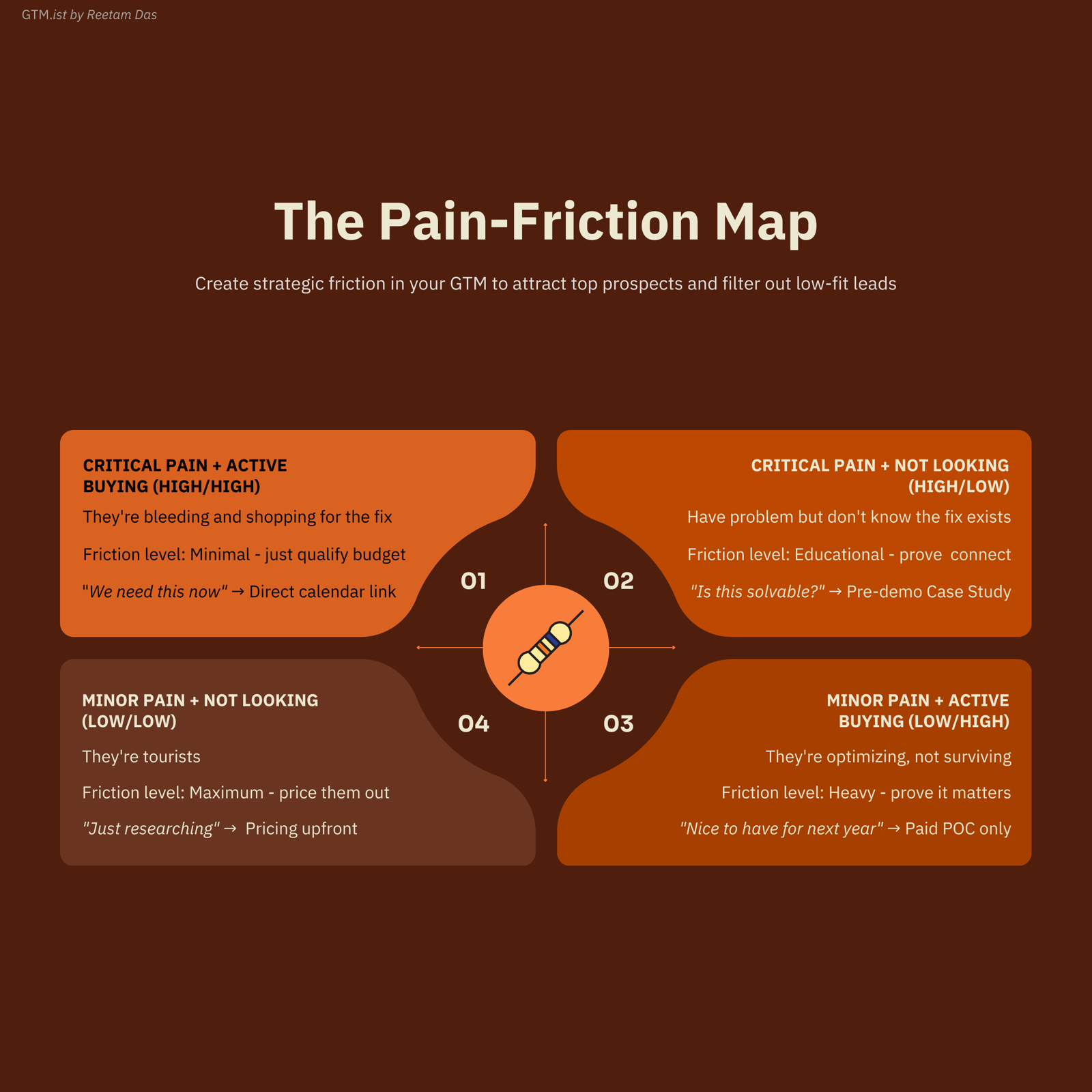
The idea is not to check with multiple ICP segments at once. You decide on a beachhead ICP, test with one segment, and repeat until you have clarity.
Friction framework steps for one beachhead (tactical)
1) Pick one beachhead
Define the exact segment. Company size, tech stack, buyer role, geography. Whatever matters. We picked “Series A SaaS companies with 20-50 employees” based on our data and guts. That’s specific. Run only this segment for a minimum of 30-60 days.
2) Start light
Add three simple gates. That’s it. Don’t overthink. We started with:
- Pricing spike ($49/mo → $499/month minimum)
- Work email required (Free ESPs get rejected)
- Two CTAs: “See Product Demo” vs “Start Free”
Track everything for 14 days before touching anything.
3) Watch these signals
Forget vanity metrics. Track what matters:
- Form fills to actual meetings
- No-show rates
- Demo to qualified opportunity
- Pipeline value created weekly
If no-shows drop 25% or demos-to-opps jump 10%, you’re onto something.
4) Level up when data says yes
Going from Light to Medium: When quality improves, but volume holds, add friction.
- Multi-step qualification form
- “Why now?“ field became required
- Demo required before trial access
Going from Medium to Heavy: When prospects start showing up prepared and cycles compress, push harder:
- Paid pilot only (killed free POCs completely)
- Manual approval for enterprise features
- $2,500 implementation fee upfront
Scary? Yes. Effective? Our average deal size went from $3K to $20K.
5) Know when to quit
Can’t move from Light to Medium after 30 days? Wrong ICP.
Stuck at Medium after 60 days? Refine your ICP.
Either the friction is wrong or the segment is. Change one.
What to expect
- Top-of-funnel will drop. Quality should rise.
- No-shows should fall.
- Demo to opportunity should lift.
Keep any gate that improves those numbers. Remove gates one at a time, strategically and based on data, if great fits bounce.
The Friction Repository
These are gates I’ve tested or seen work. Treat them as inspiration, not gospel. Your context is different - I wrote a whole post on this: Why Founders Should Ignore 90% of GTM Playbooks.
Light Friction Examples
- Switch pricing based on your ICP
- Highlight pricing on the homepage
- Tell who your product is not for on the homepage
- Require work email (auto-reject personal emails)
- Add “Book Demo” alongside “Start Free Trial”
- Embed a 2-minute Loom walkthrough before signup
- Ask for company details in signup flow
Medium Friction Examples
- Multi-step qualification (role → company → problem → calendar)
- Credit card/Signed contract before Free POC
- Demo required before trial (we hid the skip button)
- “What’s your biggest challenge?“ as required field
- 15-minute onboarding call to unlock features
- LinkedIn verification required
- Case study download before booking
- “Tell us your use case“ with 100-word minimum
Heavy Friction Examples
- Paid pilot only, no free POC (we charged $2,500)
- Manual approval with 24-hour wait
- CFO email required for trials
- Reference call required before demo
- “$10K minimum first year“ stated upfront
- Security questionnaire before access
- “Enterprise only“ with no self-serve option
Maximum Friction Examples
- Full application with essay questions (Superhuman style)
- Executive sponsor required on first call
- $5K refundable deposit for POC
- Invitation only, no public signup
- Minimum 3-year contract displayed
- “If you have to ask the price, it’s not for you“
What Actually Happens When You Add Friction?
Higher friction = faster sales cycles. Qualified buyers move with urgency. They know what they want. Extra steps don’t slow them down - they accelerate because they finally found someone serious about solving their problem.
Fewer leads = better product feedback. When noise is removed, every conversation teaches you something. Ten high-intent prospects give better insights than 100 tourists.
Rejected leads = clearer ICP definition. Every bounce is data. Where they quit, what they complain about, and which friction points break them - it all maps your real market.
Less support = more success. Browsers generate 80% of support tickets. Remove them, and your team can actually help actual customers succeed.
But What If
*“What if we filter out a whale customer?” *
You will. But that whale that can’t push through basic friction? They’d probably churn anyway.
*“What if competitors grab everyone we reject?” *
Let them. They’re taking your worst leads. You’re keeping the ones that matter.
*“What if we can’t hit our growth targets?” *
Redefine growth. 10 customers at $20K > 100 customers at $1K. Especially when the 10 stay and the 100 churn.
*“What if we picked the wrong friction point?” *
You’ll know it soon. That’s the beauty - friction fails fast. No friction fails slowly, expensively, and teaches you nothing.
The Friction Paradox
Here’s what I have learned about friction:
- Pre-PMF: More friction = faster learning = faster PMF
- Post-PMF: Less friction = faster scaling = market dominance
Most companies do it backwards. They optimize for volume when they need clarity, then add gates when they need growth.
The courage to add friction early is what enables removing it later. You can only scale what you understand. Friction creates that understanding.
Clay did this. Superhuman did this. Gong still does this.
The paradox: Making it harder to buy makes it easier to sell.