SaaS is growing differently, and you notice it in pipeline first
SaaS is still growing, just very differently. Build vs buy, AI shortlisting and vendors that sound the same all show up in pipeline first.
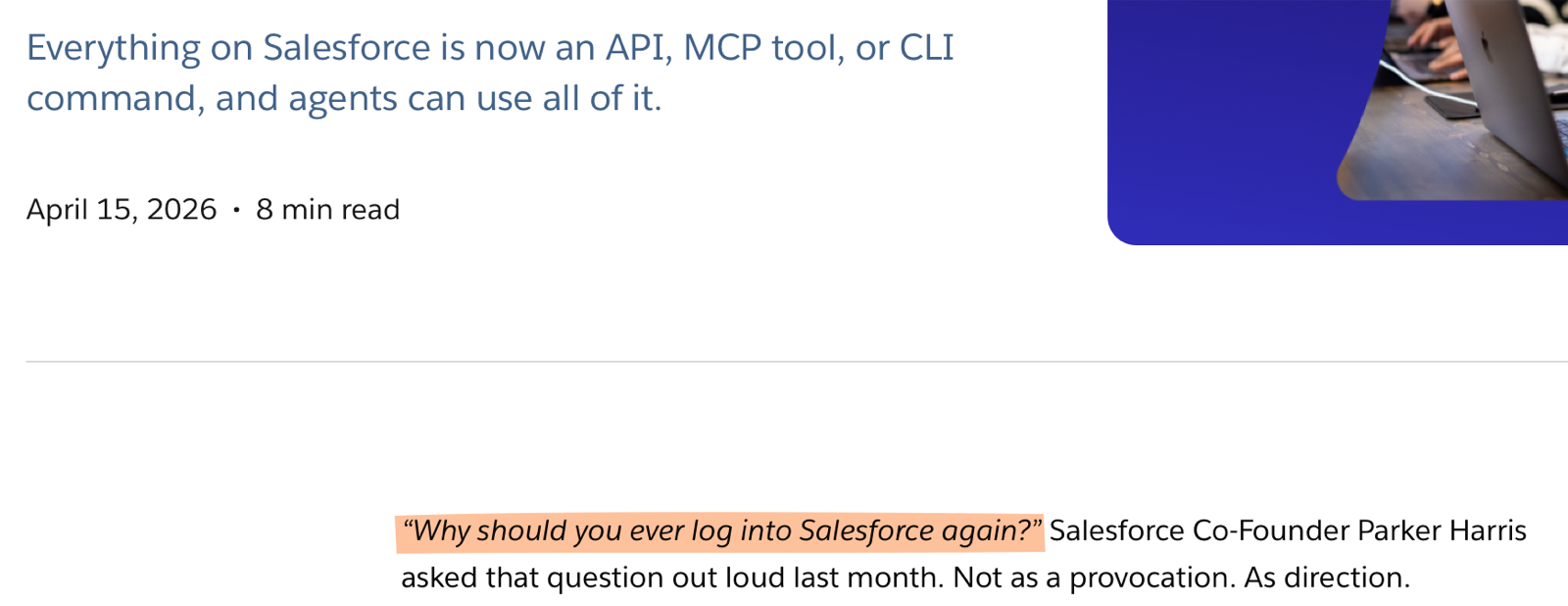
Parker Harris, Salesforce’s co-founder, asked this year, “Why should you ever log into Salesforce again?”
I think that one line says a lot about where SaaS is heading. It’s still growing, just very differently, and you notice it in pipeline first.
The data shows both sides. Public SaaS stocks were down about 20% this year by April, per Redpoint’s data. Gartner still forecasts software spend to grow about 15% in 2026.
What I’m seeing
Companies cutting while they grow
Canva let go of 22% of its staff in November. Revenue was still up 25% in the June quarter.
Growth slowed for the first time in a decade, and Canva cut its forecast because running AI cost more than expected.
Nothing I found says its users left for AI tools.
Products going headless
Salesforce quoted that line when it launched Headless 360 in April, which made every capability available as an API, MCP tool or CLI command.
Kyle Poyar looked at 50 SaaS and AI apps. 34 of them have shipped an MCP server or connector, so the product works inside Claude.
Sellers are moving the same way. David Walker quotes sellers saying “I don’t really log into my CRM anymore.”
Buyers researching with AI
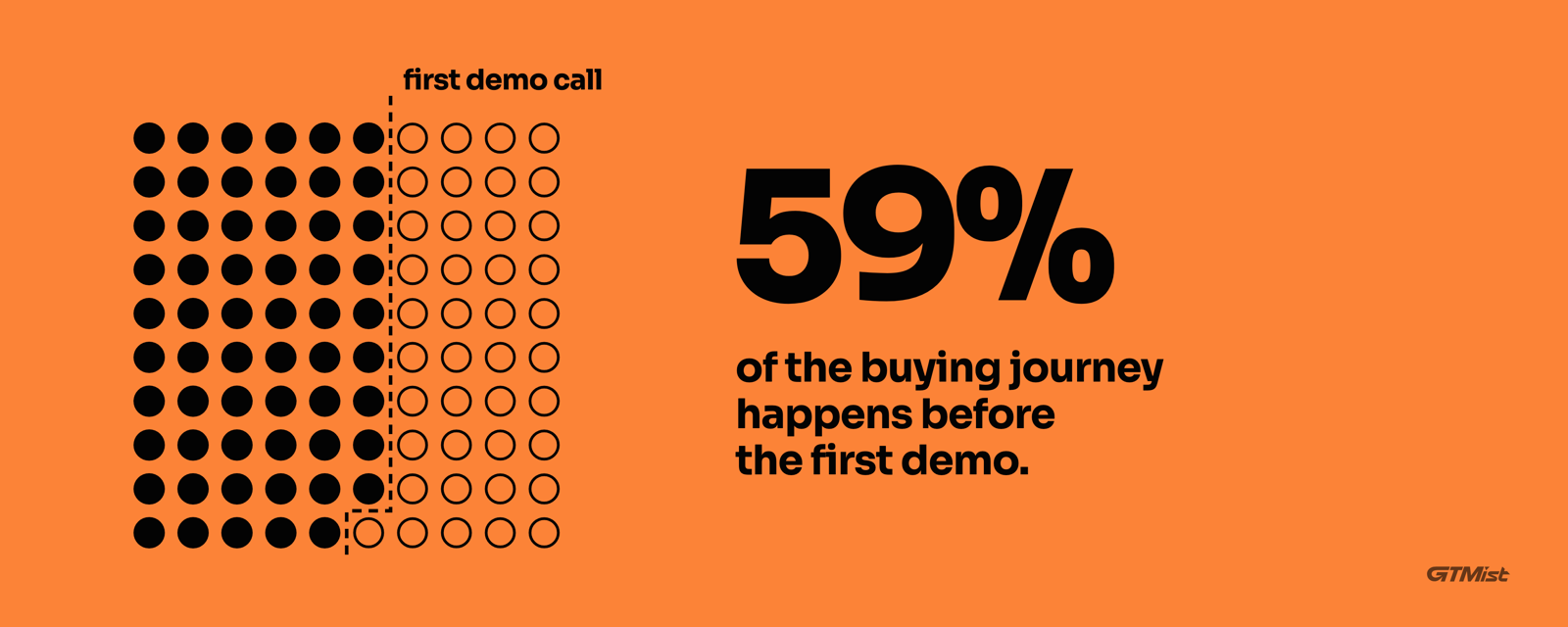
6sense studied 3,596 buying journeys. The first seller contact came 59% of the way through, and the favourite at that point won 82% of the time.
81% of those buyers used AI somewhere in the journey, more in the middle, when the shortlist gets narrowed, than at the start.
Peep Laja and Wynter collected the follow-up prompts 200 B2B buyers sent after AI named vendors. Most narrowed the list on budget, integrations or the level of service. AI can only go off what’s public.
Peep Laja’s post on the follow-up prompts
So AI-assisted shortlisting is the default now, and none of it reaches the CRM.
Adjacent plays
Wispr Flow grew with individuals who type by voice. In August, it added a meeting note-taker.
Granola grew as a note-taker for work. In October, it added voice typing.
Both now cover more of the same person’s day. I think these are bets on scale, and on proving the market.
Clear moats are harder to come by now, so it comes down to who does it better, and why a user would stick with them.
Build as an option in almost every deal
McKinsey found 32% of companies dropped at least one software purchase to build it instead. Gong’s call data shows a 45% rise in deal conversations about building in-house.
Some of us saw this coming. Adam Schoenfeld was hearing “we’re going to build it ourselves” often by 2024. I didn’t.
Most AI is still bought. Menlo Ventures found 76% of enterprise AI solutions were bought in 2025. I think build stalls more deals than it wins.
Vendors sounding the same
Atlan, Attio, Glean, Snowflake, ZoomInfo and Gong all describe what they do with some version of “context”.
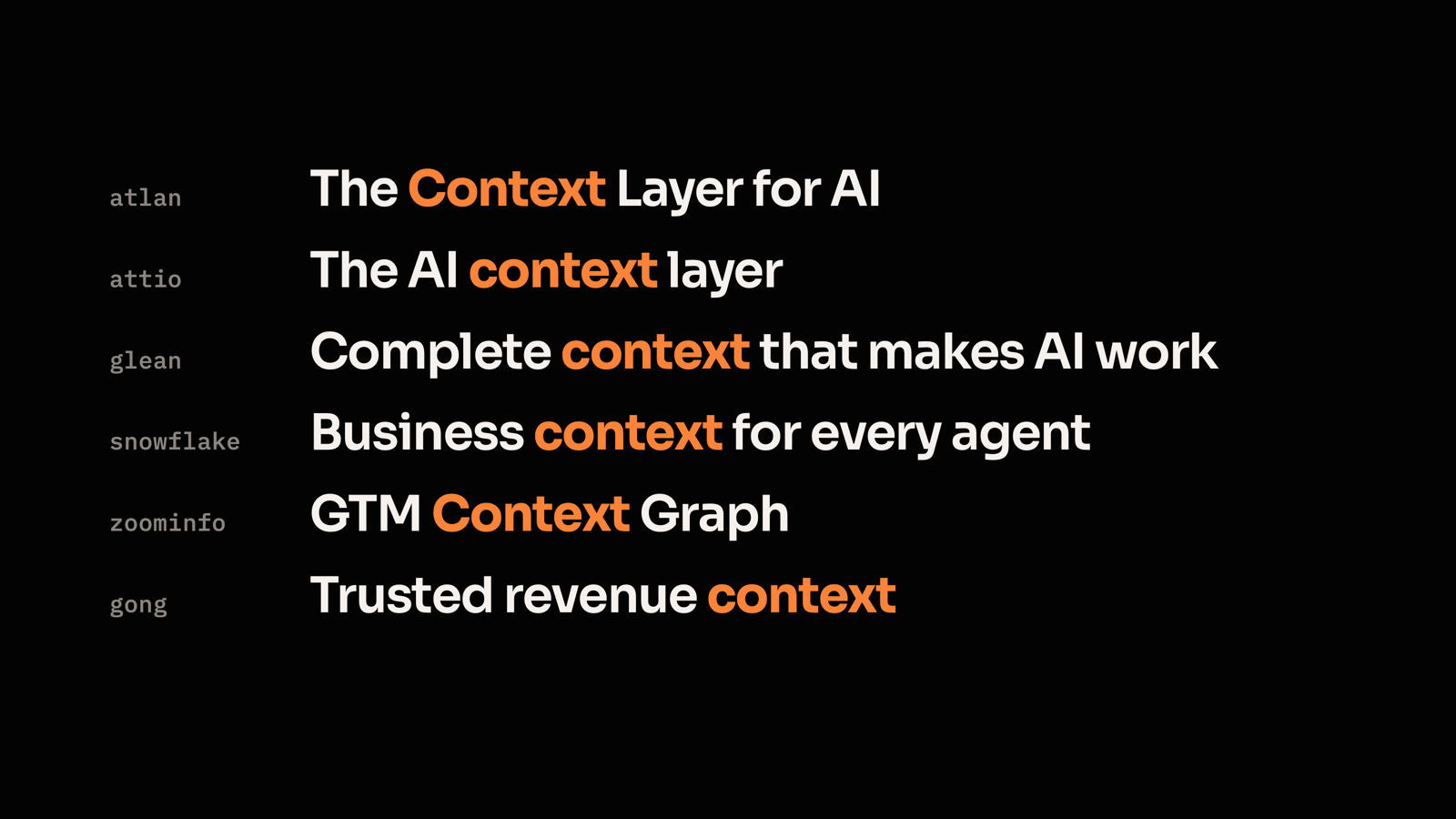
Being a context layer is fine. Saying it the way everyone else says it makes you hard to tell apart.
Wynter showed 100 B2B SaaS marketing leaders, all recent buyers, five real CRM value props with the names removed: Agentforce, HubSpot, Zoho, Pipedrive and Oracle. They matched 1.86 of 5 to the right brand. Guessing gets you 1.
These are the people who write this copy for a living.
Big players buying
Salesforce has closed Informatica and Fin, and agreed to buy Braze and Cresta.
From the outside it looks random. I think it’s a bet on owning the data and context its agents run on, so it can set the terms once things settle. It takes capital, and Salesforce has it.
Selling getting agentic
XBOW moved its BDRs under RevOps as “agent managers”, doing QA and the steps that still need a human. It went from 12 sales tools to 5.
On the buying side, people still make the purchase. G2 found only 9% of buyers would let an agent buy within guardrails.
We’ve had a correction before
Global VC peaked at $643B in 2021, and the correction came in 2022 and 2023. In my view, most companies back then were struggling with adoption.
This time the model companies add another layer. Claude’s Cowork plugins in January set off a software selloff in February. On 10 November, Claude announced Meetings, Sheets and Whiteboards.
My guess is it’s making product brainstorming rooms quieter and pushing more pivots. I haven’t found data on that yet.
What it means for pipeline
Put together, three things now happen before a seller gets on a call.
Buyers weigh building it themselves.
AI-assisted shortlisting is the default now.
Buyers can’t tell vendors apart.
So by the time “we’ll build it” comes up on a call, a lot of the deal is already decided.
Build and AI shortlisting are ICP and positioning problems. Sameness is a messaging problem. Pipeline is where you notice all three.
Answering “we’ll build it” before the first demo
I saw this with a client recently. “We’ll build it” had become a competitor they had to sell against. So we started answering it before the first demo.
- Find where build comes up in your calls, and in what form. In their calls, build showed up in a few forms. One was the “stitcher”, who mixes tools they already have instead of adding another.
- Work out what your product does that a quick build can’t.
- Get specific, and put a number on the vague claim. Irrational Labs showed 1,014 software buyers the same product page with one change. Calling the product “a team of agents” instead of “an agent” raised buying interest by 6.3 points. Their reading: buyers value a product more when they can see each job it does.
- Write the build vs buy comparison yourself, and put it where buyers research. Only 4 of Kyle’s 50 apps publish a cost comparison against building. As he puts it, when you don’t write the comparison, someone else does, usually a third party with a referral link.
One more is for product. Build with AI and not against it, or the four steps above don’t hold up. GTM can’t sell what the product doesn’t do, and 34 of those 50 apps already work inside Claude.
Do less, more deeply
You can’t say “& more” anymore.
Fewer use cases, and more depth in each one.
Get specific about your narrative, even if it sounds restrictive, because that’s the idea.
I think this is an ICP and positioning problem first, then a messaging one. Pipeline is where you notice it.
How are you handling “we’ll build it” in your deals?