We Let a Big Logo Run a 60-Day POC for 3 Years
The Capacitor Effect: how an oversized ICP killed our sales velocity, and the beachhead framework that fixed it, with a simple formula to measure ICP focus.
Three years.
That’s how long we let a “dream logo” run what was supposed to be a 60-day proof-of-concept.
At a previous startup where I led growth, we got played by our own eagerness. Big SaaS brand, marquee logo potential, unlimited POC extensions. We told ourselves it was strategic. Really, we just didn’t know who we were building for.
The problem crept up slowly, then hit all at once:
- We pitched everyone breathing in SaaS
- Couldn’t spot patterns in who bought or why
- Product roadmap looked like spaghetti thrown at a wall
- Demos felt productive; deals never closed
- High-intent leads got buried under tire-kickers
- Every week brought a new existential question: scale up or strip down?
Eventually we faced the truth: We had no idea who our actual customer was.
That’s when I discovered the beachhead ICP.
The Smallest Group That Pays Fastest
A beachhead ICP is dead simple. It’s the tiniest segment that:
- Has their hair on fire right now
- Controls the budget directly
- Needs your fix yesterday
Win them first. Stack proof fast. Let momentum build from there.
Look, positioning matters. April Dunford and Anthony Pierri (my favorite) have made that crystal clear. But most startups still try to boil the ocean with their ICP.
They think narrow means small TAM. Wrong. Narrow means fast validation.
When we finally picked our beachhead, nothing changed overnight. But the drift stopped:
- Poor-fit leads self-ejected early (even the prestigious ones)
- We could finally rank leads by actual intent
- Messaging got sharp; product direction got obvious
- Leads spent 3x less time in our pipeline (from 90+ days to under 30)
- Demos turned into actual conversations with real objections
The Capacitor Effect: Why Your ICP Size = Your Sales Speed
Here’s the physics: A right-sized capacitor hits working voltage fast. An oversized one? Just sits there soaking up current while you wait.
Your ICP works the same way.
Tight ICP (right-sized capacitor) → Concentrated GTM energy → Quick charge
Broad ICP (oversized capacitor) → Diffused GTM energy → Slow burn
Picture it:
- Input current = Your GTM efforts (sales, marketing, product)
- Capacitor size = Your ICP breadth
- Working voltage = The activation threshold for real traction
Before I show you how to measure this, let’s talk about why you need to care right now.
FOMO Is Burning Your Runway
Every early-stage founder faces the same enemy: shiny object syndrome dressed up as strategy.
Sound familiar?
- “We should target this new persona; we had a few good demos!”
- “Our competitor’s new homepage messaging is better - we need to start changing ours to match theirs fast!”
- “I heard Competitor X found success with Strategy Y; we should experiment!”
Yeah, I’ve been there. Chased every “brilliant” competitive insight. Burned cash. Learned nothing.
Most of those inspired pivots? Pure distraction.
Perplexity CEO Aravind Srinivas nailed it when he said:
Startup life means “sleeping with fear” that competitors might act first. But rather than recklessly chasing every idea, use fear intentionally, anchoring your choices in objective measures. Source
You need an objective anchor. Something that cuts through the FOMO.
The Conversion Lever Everyone Ignores
Here’s what a tight beachhead ICP actually does:
Sharper product bets: Limited runway means no guessing. Every feature ships for a validated, urgent need.
Faster feedback loops: One persona reveals patterns in days, not quarters.
Clearer messaging: One audience, one story. No confused prospects wondering if you’re for them.
Lower CAC: Platforms reward relevance. Precise targeting = better clicks = cheaper acquisition.
But as a funnel marketer, here’s what really gets me excited: conversions.
I’ve watched too many founders blame their leads when their funnel leaks. “Low quality traffic!” they say. Meanwhile their ICP is “any B2B SaaS with revenue.”
A sharp beachhead ICP creates instant resonance across your entire funnel:
- Top of funnel: Attracts only desperate buyers, repels tire-kickers automatically
- Middle of funnel: Demos shift from education to evaluation (less “what is this?” more “will this work for us?”)
- Bottom of funnel: Objections become predictable, proof points become repeatable
- Conversion rates: Every metric improves - CTR on ads, email opens, demo-to-close ratios
- Sales velocity: Shorter cycles because every conversation starts with shared context
- Product feedback: Clear patterns emerge instead of conflicting feature requests
- Future expansion: Adjacent segments self-identify, telling you exactly where to go next
Quick Self-Diagnosis: Do You Need a Beachhead?
Red flag check: you need to narrow if:
- Your average sales cycle > 60 days
- You can’t predict which demos will convert
- Product roadmap has 5+ personas fighting for features
- “Great conversation!” rarely becomes “closed deal”
- You’re explaining what you do differently to every prospect
If you checked 2+, you’re spread too thin. Time to focus.
Beachhead Focus Index (BFI): Your GTM Concentration Score
Every time I brought up narrowing our ICP, the pushback was predictable:
“Our TAM is huge. Why limit ourselves?”
“Different segments keep signing up!”
“Investors want big logos!”
“Competitor X sells to everyone!”
Subjective arguments. Emotional responses. No data.
So I built a formula: The Beachhead Focus Index (BFI).
One number that shows if your GTM energy is focused or scattered.
                  (E × C)
BFI = 100 x -----------------------
            (E × C) + (S × B × F)
Here’s what goes in:
- Effective GTM Spend (E): Dollars and hours aimed at your ICP
(Example: $6k ads + 120 hours × $70/hour = $14,400) - Positioning Clarity (C): How sharp is your promise? (1-5 scale)
(1 = “we help businesses grow” | 5 = “10-point activation lift in 30 days”) - BenchSpend (S): What your peers typically spend monthly
(Seed SaaS ≈ $20k) - ICP Breadth (B): How wide is your net? (1-5 scale)
(1 = single vertical/persona | 5 = “any SaaS”) - Friction (F): How hard is it to buy? (1-3 scale)
(1 = swipe & start | 3 = security reviews + procurement)
What Your Score Means
70+ = Tight focus. Every dollar compounds. Pour gas on it.
50-69 = Leaking energy. Sharpen message or cut scope.
<50 = Spray and pray. Pick a lane before you run out of road.
The formula keeps you honest. You control most inputs (E, C, B, F) but compete against market reality (S). Can’t game it to 100. Can’t hide from a bad score.
Quick Levers to Boost BFI
- Sharpen Clarity → Tighter promise, specific KPI
- Narrow Breadth → Drop the “also good for” segments
- Reduce Friction → Kill the security questionnaire
- Redirect Spend → Stop splitting budget across 5 personas
Now those subjective arguments? I had answers:
“Our TAM is huge!” → BFI shows we can’t even penetrate 1% with current resources
“Different segments signing up!” → BFI reveals which ones actually pay
“Investors want logos!” → BFI proves five quick wins beat one whale
“Competitor X sells to everyone!” → Their BFI is probably trash too
Here’s the contrarian truth: Everyone talks about TAM. But TAM is a vanity metric for early-stage. SAM (Serviceable Addressable Market) is what matters. And your beachhead? That’s your SAM for the next 12 months. Focus there, win there, then expand.
Gusto, Brex, Clay: How Narrow Won
The best companies started with a laughably narrow beachhead.
Gusto
What they did:
Micro-targeted California businesses with <5 salaried employees, no contractors and no benefits, and even asked to be paid eight days after payroll ran. This let them ship a “wow, not MVP” payroll flow with minimal compliance scope.
Kept burn tiny by cold-calling from a walk-in closet; almost every GTM hour went to that micro-segment.
BFI tie-back:
- ICP Breadth = 1 (single persona, single state)
- Positioning Clarity = ~4-5 (“full-service payroll for 5-person CA startups”)
- Low Friction (self-serve sign-up + concierge onboarding) → High BFI despite modest spend
“We started really, really, really narrow… Only companies that are five or fewer employees in California… and that agree to get paid eight days after they run payroll.” - Tomer London, Source: Lenny’s Newsletter
Brex
What they did:
First corporate card just for venture-backed startups, underwriting on funding data instead of profit history.
Compressed funnel: 2-minute online approval, no personal guarantee.
BFI tie-back:
- Breadth = 1-2 (VC-backed startups only)
- Clarity = 4 (“card that scales with your raise”)
- Killed Friction (instant limit, autopay) → High BFI; allowed heavy paid acquisition later
“We rebuilt the stack and created a card specifically to meet the needs of startups.” - Henrique Dubugras, Source
Clay (pivot to beachhead)
What happened:
Spent years riding every inbound “could you also…?” request - recruiters, engineers, finance, etc.
Friction skyrocketed; GTM hours diffused, BFI < 20.
2022 pivot: outbound-sales power-users only; rewrote docs & marketing, cut features.
“When you narrow the scope, it feels claustrophobic… Eventually we realized that by narrowing our scope we were actually increasing our value.” - Kareem Amin, Source
Post-pivot BFI levers:
- Breadth dropped from 4 → 1
- Friction dropped (playbooks, templates), effective spend concentrated → BFI leaped, revenue followed
The 5-Day Beachhead Sprint: From Fuzzy to Focused
Ready to find your beachhead? Here’s the exact sprint I run.
Five days. Five steps. One clear ICP.
I’ll show you using LaunchPulse, our hypothetical PLG analytics tool.
Day 1: Gather Pain Quotes
(Their words, not yours)
Scrape 15-20 real complaints about activation or onboarding pain. Look for:
- Specific friction points (“users drop at step 3”)
- Company stage markers (“we’re seed-stage”)
- Role identifiers (founder, growth PM)
Copy them verbatim. These exact words become your messaging.
Best for: Early-stage SaaS (pre-customer or with a handful of pilots). If you’re more mature with existing customers, layer in actual customer interviews. But still start with public pain to spot patterns you might be missing.
Where to hunt: Reddit, G2 reviews, LinkedIn posts, Canny boards
What LaunchPulse found:
“Our activation rate drops after day one - no idea why” (Founder, Pre-seed)
“Free trial users don’t hit the ‘aha’ moment” (Growth PM, Series A)
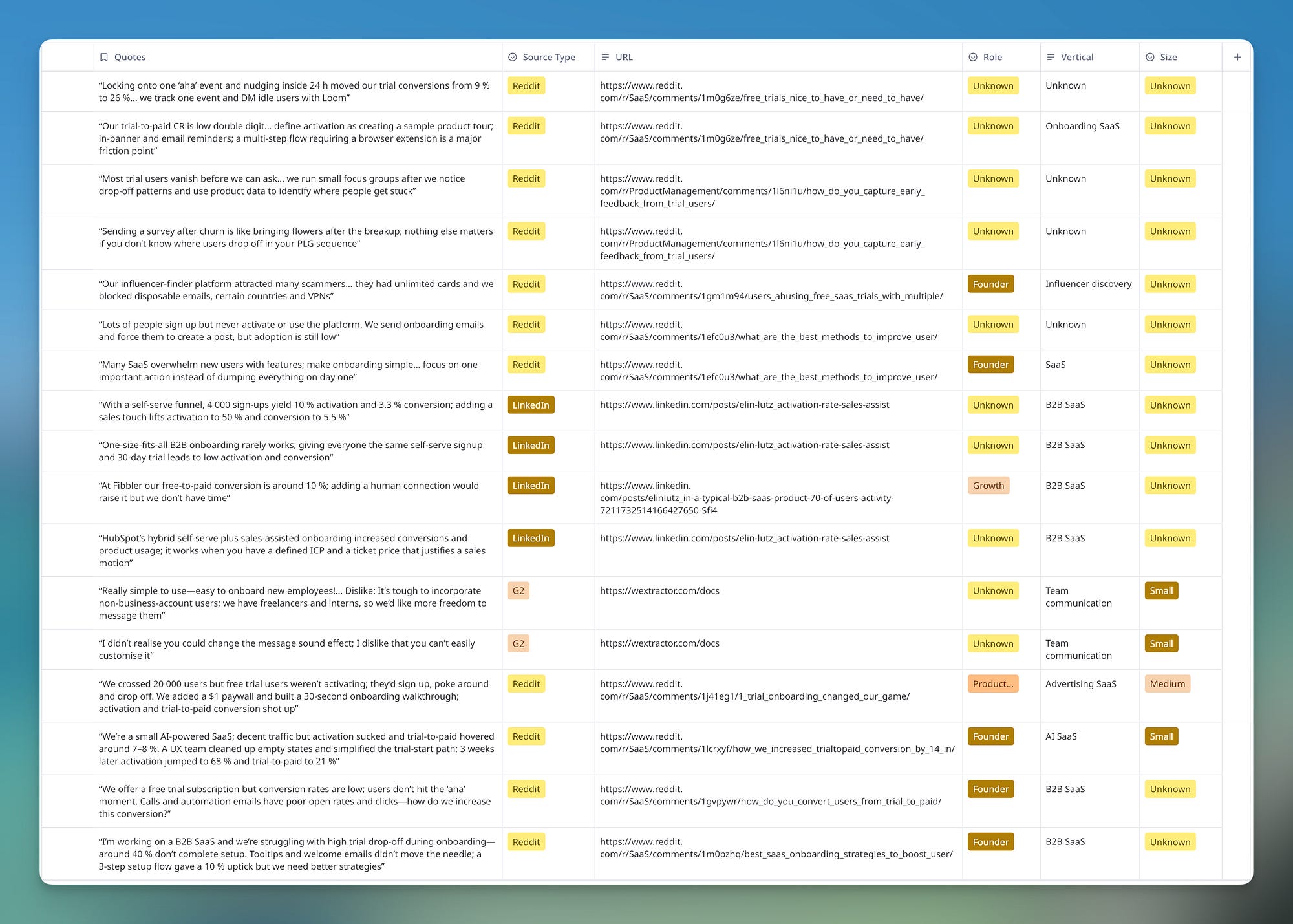
Zoom in to the Pain Quotes DB here →
Day 2: Build the ICP Grid
(Map the battlefield)
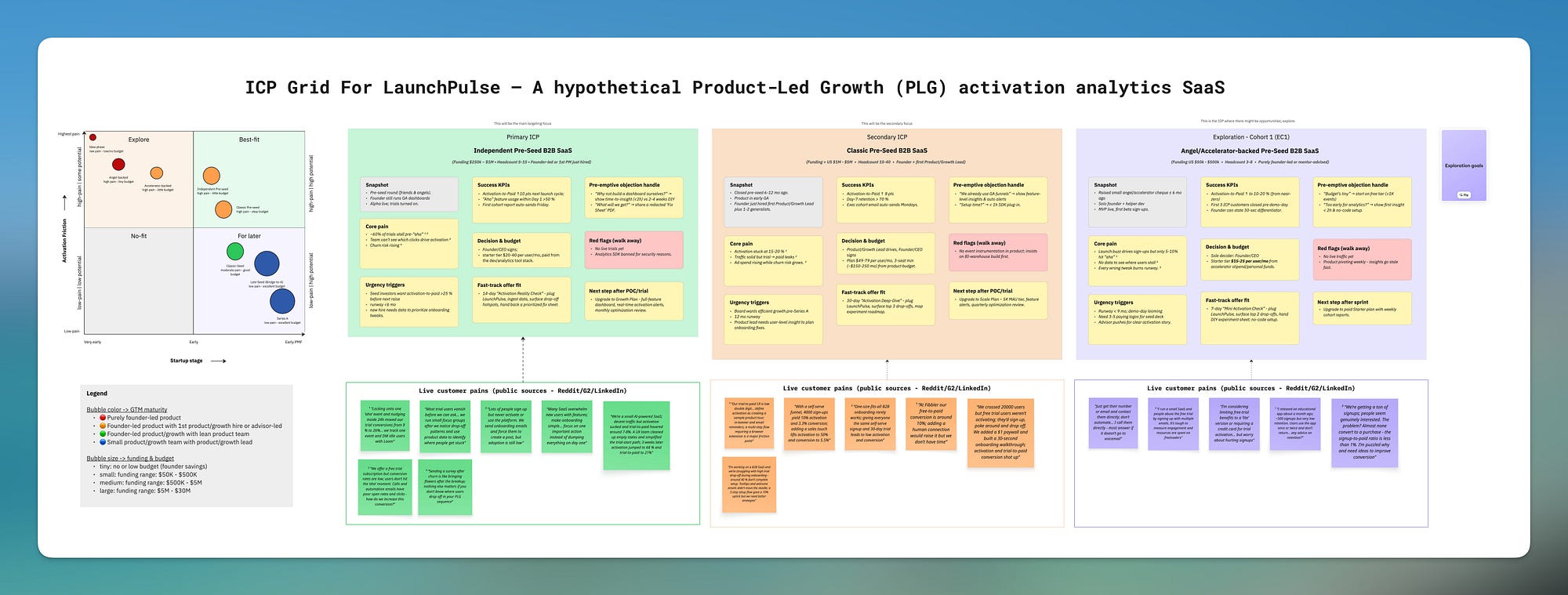
Cluster your quotes into 3-4 segments. Plot them:
- X-axis: Stage & Budget
- Y-axis: Pain intensity
- Bubble size: Available funding
- Color: GTM maturity
You’re not choosing yet. Just mapping where pain meets money.
Map each ICP segment:
- Firmographics: Industry, size, funding stage
- Role & Team: Buyer, user, budget-owner
- Pain Intensity: High / Medium / Low urgency
- Buying Triggers: Events that push action now
Day 3: Choose Your Beachhead
(Pick one, ignore the rest)
Score each segment on:
- Pain urgency: Are they desperate?
- Budget control: Can they buy today?
- Speed to win: Can you prove value in weeks?
Pick the highest scorer. Everything else waits.
LaunchPulse picked:
“Independent Founders at Pre-seed SaaS companies - urgent activation pain, direct budget control, proof in weeks.”
Day 4: Create the Clarity Canvas
(One page, one promise)
Document your beachhead:
- Snapshot: Who they are, team size, stage
- Core pain: Their exact complaint quotes
- Urgency trigger: Why they need you NOW
- Success KPIs: Measurable wins in 30 days
- Your promise: One sentence, one specific outcome
- Quick-win offer: Sprint/POC tailored to this ICP
- Emotional shift: From frustrated to confident
LaunchPulse promise:
“Give us an hour to install; get a ranked list of drop-offs and a 10-point activation lift inside 30 days.”
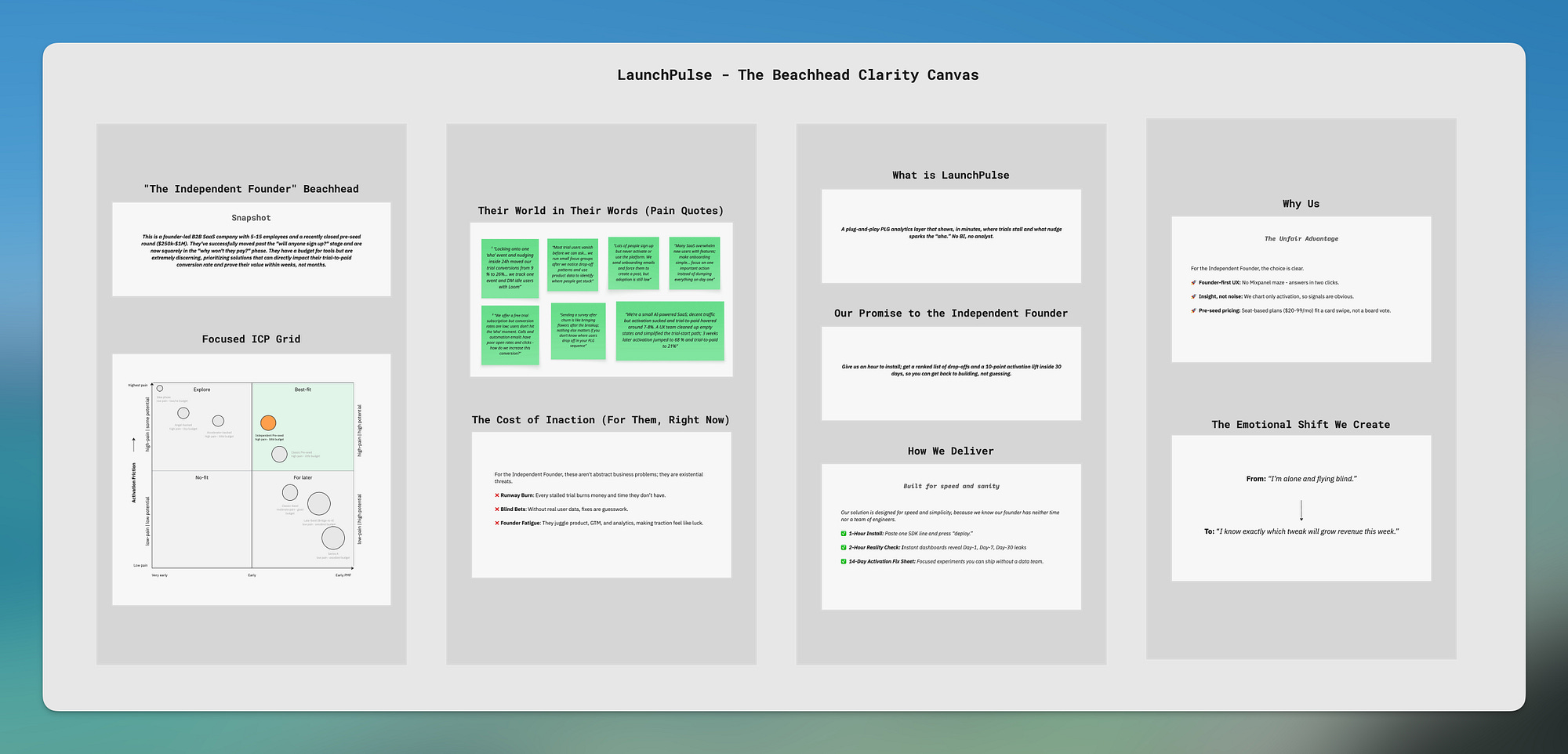
View LaunchPulse’s Beachhead Clarity Canvas here →
Day 5: Calculate Your BFI
(Measure your focus)
Run the numbers:
LaunchPulse inputs:
- Effective Spend: $12K
- Clarity: 5 (specific KPI promise)
- BenchSpend: $10K
- Breadth: 1 (one persona)
- Friction: 1 (easy setup)

BFI = 100 × (12,000 × 5) / [(12,000 × 5) + (10,000 × 1 × 1)]
BFI = 85.7
Translation: BFI of 85.7 means we’re focused enough that every new customer makes the next one easier to win. Pattern recognition kicks in. Sales cycles shrink. Word-of-mouth compounds within the niche.
BFI >80? Full speed ahead. You’re focused.
Bonus: Build Market Signals
Turn your ICP into trackable triggers.
Instant-fit signals:
- Pre-seed funding <$1M
- Team size 5-15
- Segment/Userpilot in their stack
Intent signals:
- Hiring “Customer Success” role
- Founder posting about trial conversion
- “Getting Started” page just launched
Track these. Score leads before calls. Stop wasting time on poor fits.
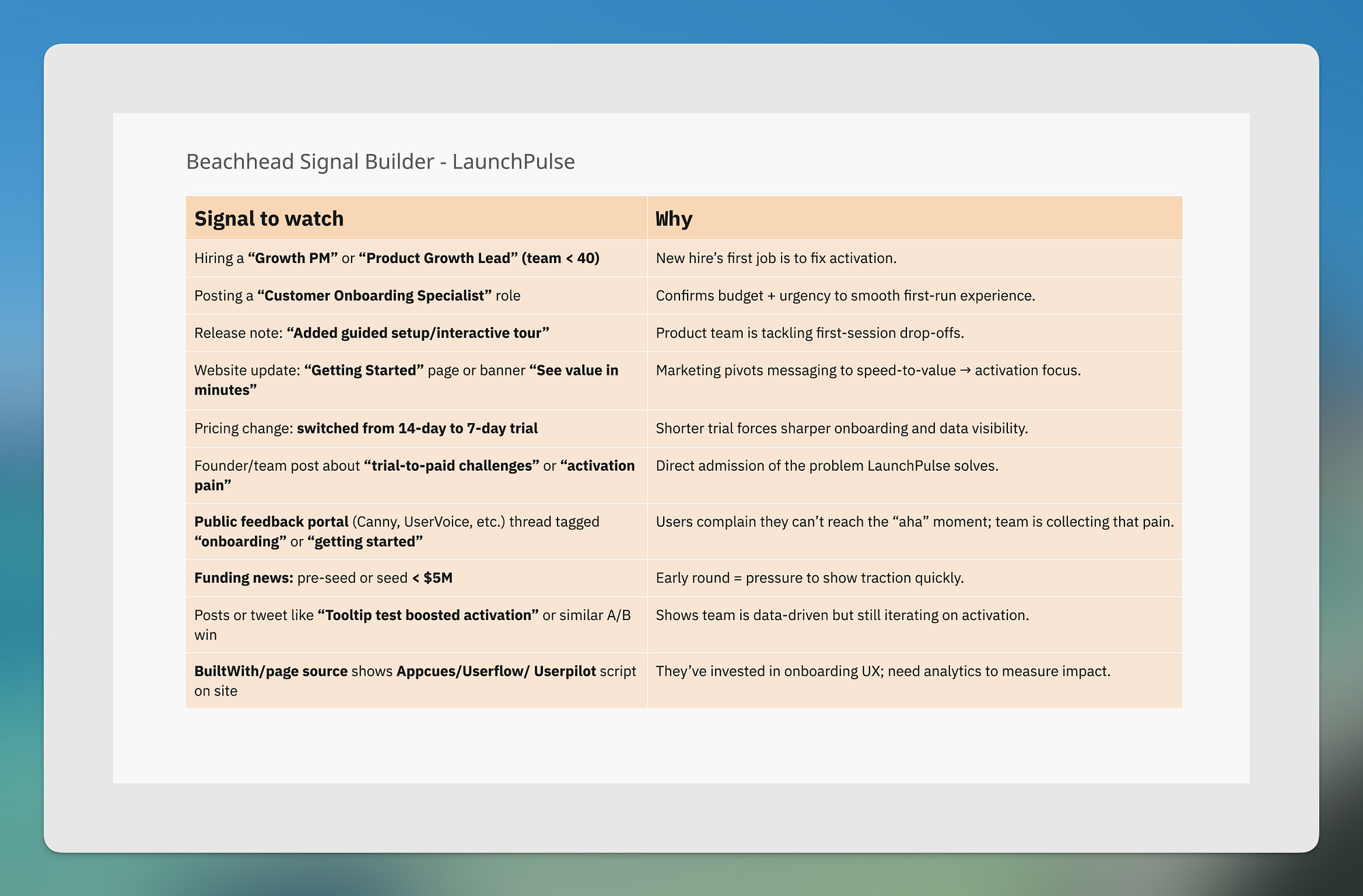
View LaunchPulse’s Signal Builder Cheatsheet →
When to Re-run This Sprint
- Growth stalls despite steady spend
- BFI drops >15 points
- You’re entering new territory
Each run sharpens focus. Charges your capacitor faster. Shortens cycles.
The Bottom Line: Charge Fast or Die Slow
Here’s what that 3-year POC taught me: Every day you waste charging a broad ICP, your focused competitor closes three deals.
The math doesn’t lie. BFI under 50? You’re running a charity for tire-kickers. Every “great conversation” with a maybe-someday prospect costs the same hour you could spend with someone desperate for your solution.
Three things to remember:
Your beachhead isn’t your TAM. It’s your proof-of-concept market. Win there first, expand later.
Narrow feels wrong until it works. That claustrophobic feeling? That’s focus. Clay felt it. Then they grew.
The formula keeps you honest. BFI beats arguing about “market potential” in board meetings. Numbers > opinions.
If you only do one thing: Calculate your current BFI.
Under 50? You know what to cut.
Your Beachhead Toolkit
I’ve documented exactly how I built this for LaunchPulse. Steal everything:
- 📊 BFI Calculator: Formula to calculate Beachhead focus with examples
- 💬 Pain Quote Database: Real complaints that shaped LaunchPulse’s beachhead
- 🗺️ ICP Grid: Visual framework for finding your beachhead
- 🎯 Clarity Canvas: One-page ICP definition framework
- 📈 Signal Builder: Triggers to spot ICP-fit leads instantly
Remember: A charged capacitor delivers power. A half-charged one just sits there, humming.
Choose your charge wisely.
P.S. Still running POCs longer than 30 days? Your ICP is likely too broad. Calculate your BFI first, then revisit those deals.